
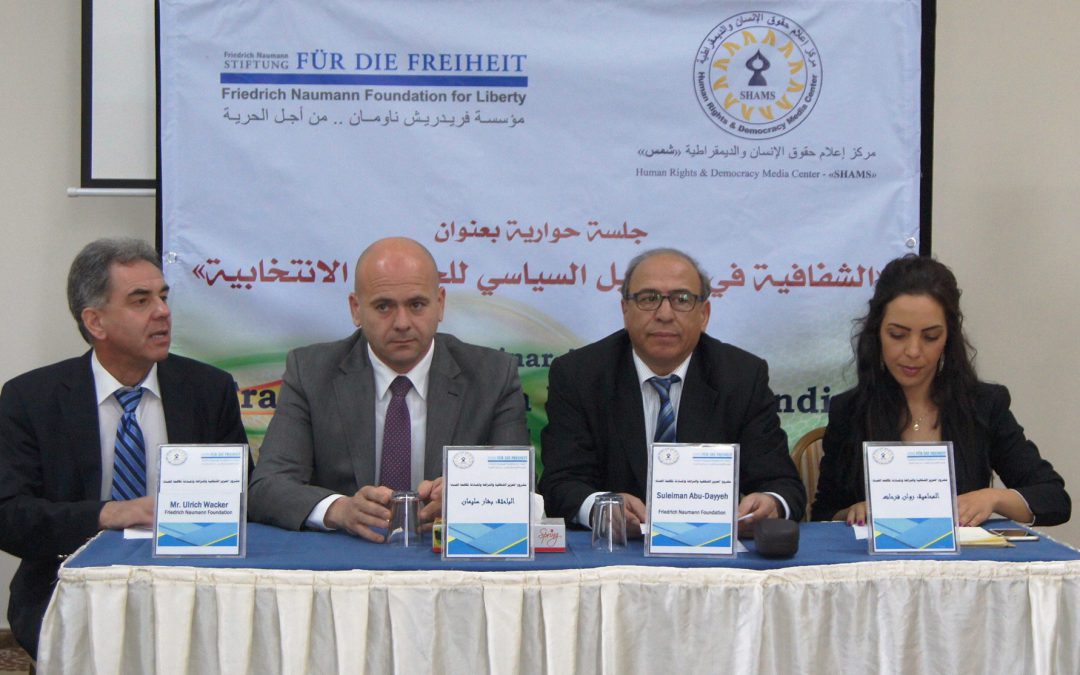
Ramallah: Human Rights and Democracy Media Center “SHAMS” organized a seminar about transparency in political funding for electoral campaigns, in Ramallah funded by Friedrich Naumann Foundation for Liberty (FNF). The event combined several participants from civil society organizations, political factions, official institutions, in addition to lawyers and some heads and coordinators of electoral lists. Advocate Rawan Farhat initiated the seminar who put emphasized that transparency and neutrality of the electoral process is considered the priority to guarantee trust in the electoral process and acknowledgment of its results. She highlighted that utilizing money in politics by uncontrolled political funding will affect the impartiality of elections. Since direct contributions within elections and other forms of financial support in some cases may represent a form of political influence.
Director of Friedrich Naumann Foundation for Liberty mentioned that oversight of electoral campaigns aims at enhancing impartiality, transparency and accountability of the electoral process, not only in Palestine but also in all democratic regulations. And paving the way to establish a legal and procedural framework to control funding of electoral process since uncontrolled funding may result in different aspects of electoral corruption, or affecting elections’ impartiality. Neutrality of elections represents the base for evaluating the success of elections according to the neutrality of electoral system, the supervising entity, electoral process and participating parties either candidates or voters.
The researcher in electoral affairs Bashar Suleiman said that in spite of having Palestinian legislations which control spending in elections however, events occurred on the ground during the elections in Palestine, assure that these texts haven’t stopped all electoral breaches. In light of having such legal texts, the majority of candidates exceeded the maximum of spending, and these texts haven’t been applied practically due to many reasons. Including the lack of legislations to put an end to breaches, some legislations are not applicable and the absence of qualified trained entities which could control breaches occur within electoral spending.
Mr. Suleiman put emphasis that documenting and auditing costs of electoral campaign will contribute to opposing and preventing the phenomenon of purchasing votes. So, candidates or members of the lists will be forced to spend money in which they can document or audit only by bills and receipts. Accordingly, activating the role of government’s control entities and civil society organizations active in elections’ affairs and combating corruption, related to oversight of electoral costs is an important mechanism to control funding electoral advertising.
Participants came up with a set of gaps in the Palestinian legislations in regard to spending of electoral advertising if compared to international standards. Such as not addressing the matter of funding and spending of electoral advertising by the Palestinian legislations. Additionally, Palestinian Law hasn’t tackled the principle of government public funding, allocating a unified open bank account for the electoral list to be observed. Besides, legislations haven’t tackled funding campaigns by numerous sides like money gathered through illegitimate sources like burglaries or crimes. And not forcing candidates to reveal members of their electoral campaigns, the absence of oversight’s mechanisms to control funding campaigns in light of only waiting to deliver financial accounts within a month of finishing the campaign to the related entities.
At the end of the session, participants presented recommendations to be taken into consideration by stakeholders. Like establishing a department in the Central Elections Commission CEC to follow up political funding, and treating all candidates and electoral lists equally by media outlets in terms of costs of advertising and terms of contraction. Furthermore, enhancing control of funding electoral campaigns, assuring that only specific amounts and contributions of electoral spending are spent, and imposing prohibition on of donoations. Also, setting mechanisms to control spending of electoral advertising by the Central CEC and civil society organizations and to specify how to spend the remaining money after electoral advertising. Moreover, assuring that financial sources for electoral advertising are legitimate, allocating a limit for spending of local authorities elections and providing a supervising power for the CEC in terms of declaration, audit and interrogations.