
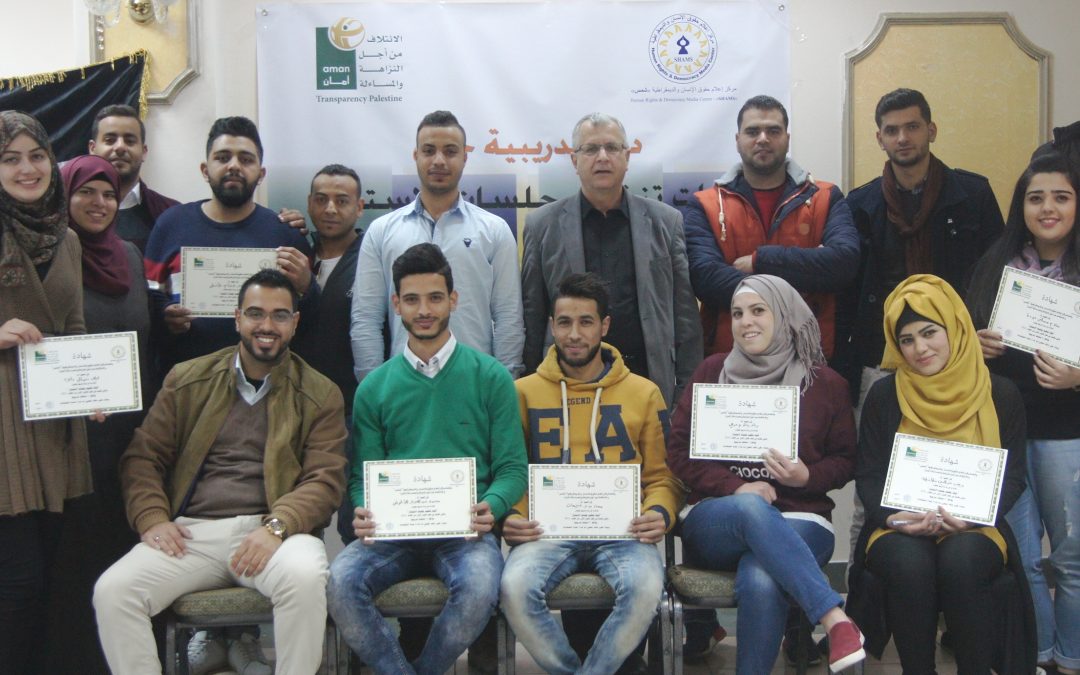
“SHAMS” Center concludes a training course for university students
On mechanisms of arranging hearing & accountability sessions
Ramallah: Human Rights and Democracy Media Center “SHAMS” conducted a training course for university students on the on mechanisms of arranging hearing & accountability sessions. The course was held for students at Al-Quds Open University, Arab American University, Aldus University, Hebron University, Birzeit University and An-najah National University) for the duration of 3 days in collaboration with Coalition for Integrity and Accountability AMAN. Training course was initiated by Adel Ghaithan from SHAMS center, who welcomed the attendees and explained that it aims at building the capacities of youth, and providing them with basic skills required for designing and conducting hearing sessions. Besides, it aims at raising awareness, exchanging experience on the concepts and applications of social accountability. As well as putting the spotlight on the best practices for tools of social accountability and focusing on the importance of social accountability in improving public services.
The trainer was supervised by Majid Salih who explained the elements of hearing sessions, and mentioned that hearing sessions are considered as significant tools implemented by officials to get citizens involved in decision-making. But, hearing sessions vary in terms of the level of citizens’ interest and participation, having the will among decision-makers to listen to citizens and take their perspectives and notes into account. As an example, some hearing sessions aim at informing and identifying citizens on decisions made by officials, and such type are not considered as discussion but held only by one party (decision-makers) and the other party only listens (citizens).
He added that discussion sessions are another type in which stakeholders exchange opinions and suggestions however, such type are not obligatory for decision-makers. Additionally, there is another type which is the most serious one which differs in terms of debates and voting for a certain decision made during the session, while decision-makers should abide by it. In order to guarantee the efficiency and transparency of the sessions, and to make information on the discussed accessible preceding the time of conducting sessions to be studied. Also, shareholders should get involved with freedom of expression equally without favoritism.
It is worth noting that training course addressed the concept of hearing & accountability sessions, mechanisms for arranging the sessions, techniques to be followed when arranging a session. Furthermore, how to move from theory to practice regarding social accountability through identifying concepts of hearing sessions, its tools and application. In addition to the way of activating youth role in arranging hearing sessions and social accountability, and how citizens and civil society are involved in decision-making and identifying new cases of social accountability applied in other countries. Also, finding appliances which meet the requirements of local communities for enhancing efficiency of social accountability through hearing sessions. The training course tackled theoretical and practical training, simulation, case study and working groups.
Also, Salih added that Palestinian Law hasn’t mentioned details pertaining to hearing sessions, its mechanisms or to what extent do its outcomes force the executive entities. Also, it is not considered as a step to get the community involved in decision-making. But in a state like Palestine, many voices arise to call for enacting a law to regulate arranging hearing sessions in transparency and in a participatory approach. Civil society should assume a clear and officially recognized role for the purpose of monitoring the phases of hearing sessions, and making sure that citizens are informed about it, as well as obvious adequate information are accessible. Currently in Palestine, theoretically, it seems that executive power seriously takes the findings of hearing sessions conducted by civil society organizations into consideration. But, this is not enough to check the efficiency of hearing sessions and the scope of adherence to citizens’ opinions and consider it abiding.
At the end of the training, attendees emphasized that hearing sessions represent a kind of civilian oversight which contributes to enhancing democracy, transparency and achievement of stability and development and combating corruption. It is also linked with the right to access information and protecting whistleblowers. Hearing sessions help is getting the civil society involved in the process of development and management of the public affairs and welfare. Furthermore, it is considered as a kind of information and skills required for local communities. Consequently, hearing sessions contribute to improving public services through using social assessment cards and citizens’ reports cards. Also, contribute to generalizing the concepts of accountability, transparency and accountability which are regarded as necessary step towards developing political regimes to accomplish interests of citizens and collaboration with the ruling authority.