
Call for developing a comprehensive national plan towards enhancing integrity and combating corruption based on participatory approach
During a seminar held by “SHAMS” center
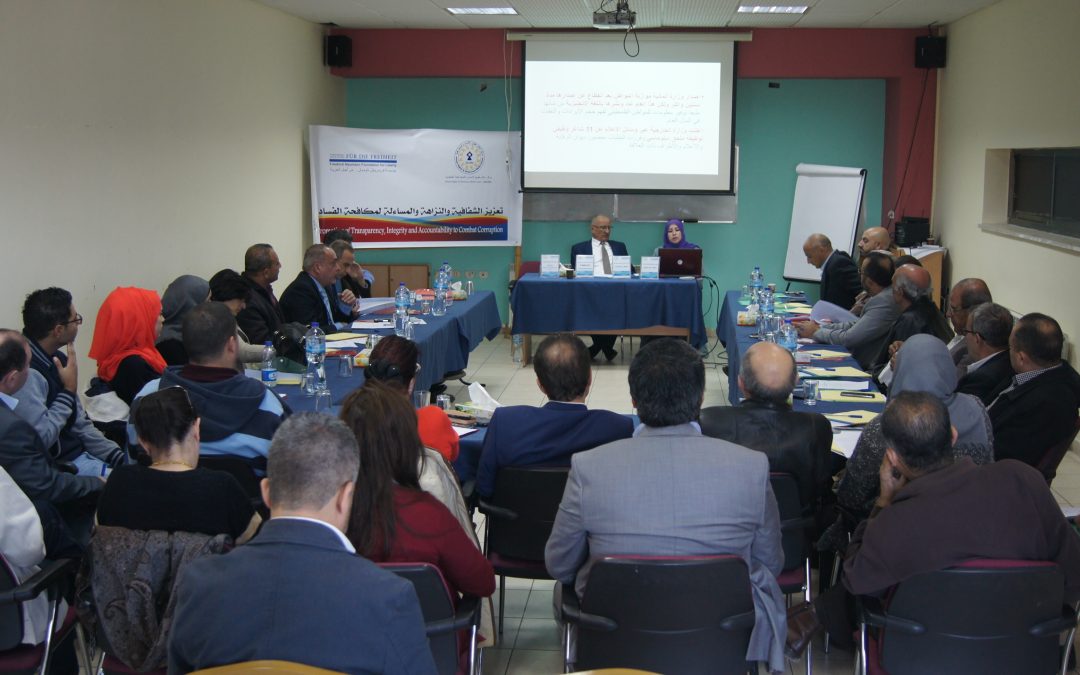
Ramallah: Human Rights and Democracy Media Center “SHAMS”, in collaboration with Friedrich Naumann Foundation for Liberty “FNF” a seminar to discuss a study on “practical measures taken by the Palestinian Authority to combat corruption” , in light of the United Nations Convention against Corruption UNCAC. This session is a part of a project being implemented by “SHAMS” and “FNF” in the West Bank governorates, pertaining to the basics of good governance in the local government sector.
Dr. Azmi Alatrash – Dean of Development Institute at Al-Quds University inaugurated the session and welcomed the attendees. Also, he explained the goal of the study which is to put the spotlight on practical measures taken by the Palestinian Authority to combat corruption, following the accession to the UNCAC, in addition to positive developments or existing gaps through observing and studying the achievements. Then, analyzing data in order to come up with recommendations which contributes to decision-making.
The researcher Sumoud Barghothi from AMAN organization, who prepared the study mentioned that since signing the agreement in 2014 the government has made efforts towards enhancing integrity, transparency and accountability in some fields. However, such anti-corruption efforts are seasonal and not organized due to not adopting a holistic, detailed and well-structured plan. in terms of activities and interventions which promote integrity, transparency and accountability in the public jobs according to a timeframe. She added that some related measures has been taken by the government, in which public complaints ‘authorities was activated, and the State Audit & Administrative Control Bureau issued specialized reports for the purpose of saving public funds and restricting corruption opportunities.
In regard to transparency, activating observance of public procurement law no. 8 of 2014 and accession to the open initiative of the government and ratification of the Cabinet in 2015, to formulate a national team to join the open initiative. Moreover, the government passed the system of allowances and financial rights for Board members that government contributes to its management. And issuing the citizen’s budget by the Ministry of Finance for the purpose of adhering to governance basics. So as to reduce the waste of public fund, the government issued austerity and saving decisions. In terms of organizing the use of public vehicles in the public service, saving 50% of contracts of 2016 for each governmental department, except for Ministries of Health and Higher Education. Besides, issuing legislations necessary to apply the table of wages, allowances annexed to public service law on the heads of non-ministerial institutions and public authorities, on employees and workers. And implementing a program to prepare leaders by the General Personnel Council at the beginning of 2016, aiming to improve the performance, efficiency of staff members in charge of supervision within public sector.
In regard to integrity, adopting a code of conduct and ethics for public jobs by the government in 2014. Then followed by launching education and raising awareness program and training on the code of conduct between the General Personnel Council, Anti-corruption Commission and the Cabinet. Farther, training high ranking positions on how to counter money laundry, and conducting specialized training courses in this regard by the Public Prosecution and Palestinian judicial Institute. Which included the judges of Corruption Courts, -Anti-corruption Prosecution, and Economic Crimes Prosecution.
Concerning efforts to restrict nepotism and favoritism, the Cabinet endorsed the table of functional formulation for 2016, developed by the General Personnel Council, in cooperation with Ministry of Finance and related governmental institutions. Additionally, the General Personnel Council followed a set of measures aiming to reinforce principles of transparency and integrity in the recruitment of temporary contracts in the public jobs. Such recruitments were implemented based on advertising, competition and interviews then connecting it with occupational description cards. Also, it is forbidden to recruit contract-based people for those who have first degree relatives in the same department to limit nepotism.
At the end of the meeting, participants recommended to disseminate the UNCAC in the official newspapers. And to develop a national comprehensive plan which unifies efforts for enhancing integrity and combating corruption, based on participatory basics to be nationally accredited and adopted. In addition to begin implementing procurement law in terms of by-laws, instructions and possibility to apply it, and to develop a system for tenders of local authorities. They also recommended the importance to involve the civil society as well as organizations working in the field of enhancing transparency, integrity, accountability, rule of law, and respect for human rights, protecting the consumer and coordinating efforts for combating corruption. Furthermore, raising awareness and public culture against corruption, ratifying the right to information law and signing mutual agreements with states to facilitate asset recovery and delivering criminals.