
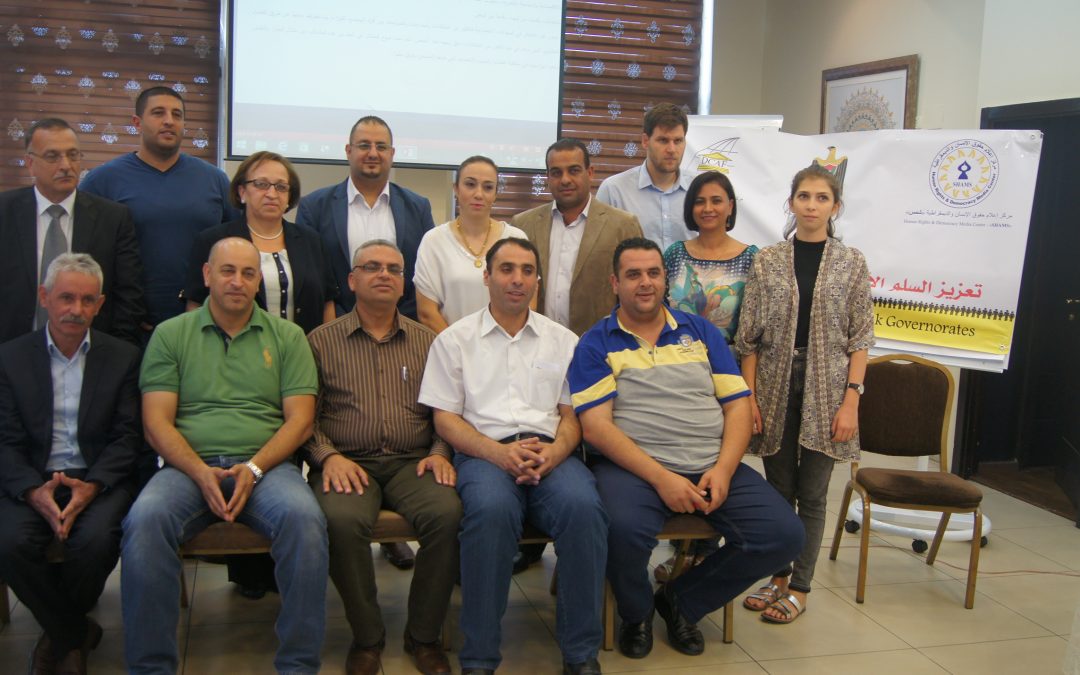
Ramallah: Human Rights and Democracy Media Center “SHAMS” and the Geneva Center for the Democratic Control of Armed Forces “DCAF” concluded a training course on enhancing community safety in the West Bank governorates. The training course combined representatives of legal departments, tribes and gender from the governorates of Ramallah & Albireh, Bethlehem, Jenin, Tulkarm and Hebron.
At the beginning, Haya Sakakini representing DCAF welcomed the attendees, and mentioned that training course is a part of a joint activity with five governorates, in order to develop strategic plans for Bethlehem and Tulkarm. It is worth noting that strategic plans were developed for the governorates of Hebron and Jenin. She added that reinforcing community safety and resolving disputes is a Palestinian social requirement and priority.
On the first day, the trainer Huthaifa Said addressed the topics of communication and democratic citizenship in terms of rights and duties. He stressed the importance to enhance the concept of citizenship in the community due to its contribution to the reinforcement of accepting others and correct communication. Besides, Said mentioned that concept of citizenship is a contractual relation between the state and individuals, represented by the political system, while the fundamental sense of citizenship indicates dignity. Also, pluralism and tolerance are the basics of communication which requires effective actions and efforts towards the achievement of community safety and social cohesion.
The trainer Iyad Shtayeh presented the content of the training as well as timeframe, then discussed them with participants. He wished that training course will add new information to the trainees, to increase their understanding of community safety issues more successfully and efficiently. Moreover, he clarified the concept of community safety and the increasing number of violence cases due to limited awareness of peace, citizenship and social culture. He added that violence prevails in the human communities and it is hard to speak about violence and community safety with some groups. Like detainees and girls who were exposed to violence by the Israeli occupation, and others who witnessed displacement and excesses of war.
Participants mentioned that environment influence on the formulation of human personality and both violent / correct behaviors. They assured that violence is practiced based on the absence of choices and defeatism, while education contributes to the enhancement of community safety culture and violence is unacceptable and unjustifiable. The weakness of the Palestinian judiciary and absence for the rule of law represent the main reason for the prevalence of violence in the Palestinian community. One of the participants emphasized that pardon and conciliation in social cases is a hard decision and may be only achieved by powerful parties who are capable to make change. Additionally, participants described some personal experience in regard to community safety and related impediments.