
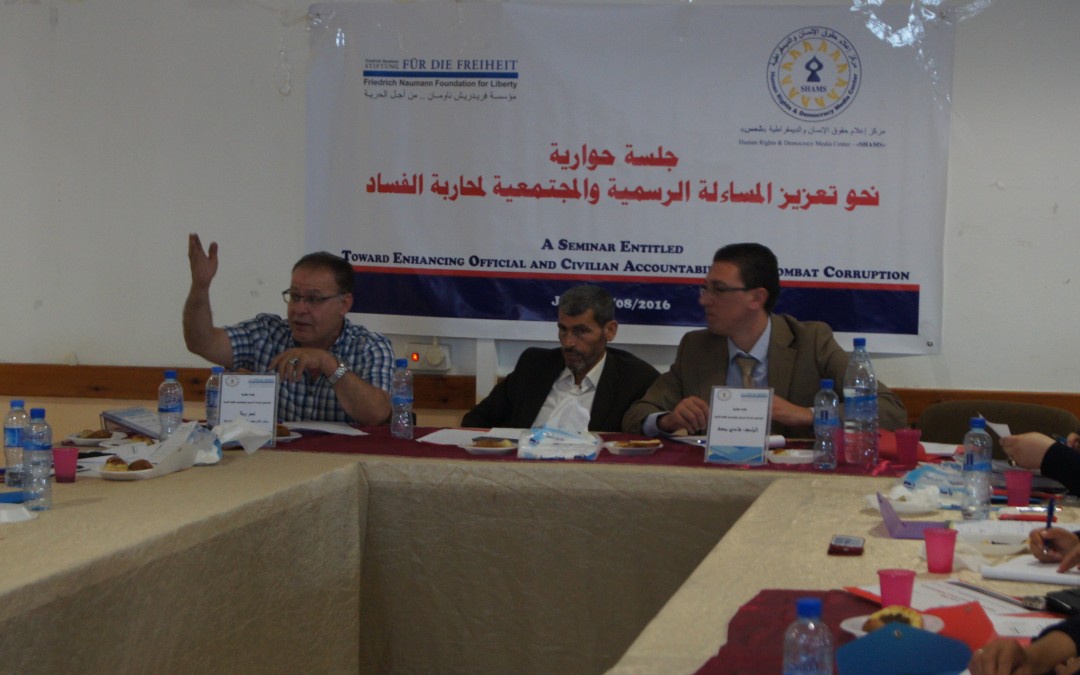
Jenin: Human Rights, Democracy Media Center “SHAMS”, and Friedrich Naumann Foundation for Liberty “FNF” conducted a seminar about the performance of Jenin municipality. The meeting represent an activity of the project being implemented by the two organizations in the governorates of the West Bank pertaining to the basics of good governance and the services provided by the local authorities. The project aims at activating civilian and official accountability of the local authority regarding services provided by local authorities. Additionally, enhancing transparency and integrity of its work in terms of disseminating information and giving a space for people to have identify. Several people joined the seminar including municipality members, researchers, advocates and representatives of civil society organizations and Ministry of Local Government.
The researcher and political sciences instructor at Arab American University Fadi Jumaa initiated the meeting and emphasized the importance to come up with findings and recommendations. Which will contribute to advancing the municipal work and delivering better services to the citizens. He also presented the themes to be addressed in the meeting like mechanisms of transparency and integrity, system of incentives and allowances, periodicity of meetings, internal control. In addition to mechanisms to receive complaints, equality in delivering services, promoting participation and communication with local community, publishing reports and the right to access information.
Dr. Mustafa Sweitat, deputy Mayor of Jenin Municipality assured that the municipal council was the result of bad financial system and administrative structure. He added that there are 463 employees at Jenin Municipality whose salaries reaching 1,400,000 NIS. He explained that the municipality don’t require such large number of employees, and admits that no one could neglect the problem of the municipality. There is a need to stop the breaches and neglect.
In other regard, the engineer Iyad Khalaf, General Director of Local Government mentioned that responsibility is premised upon citizens. Either through electing unqualified municipal members or through failure of the local community to defend their human rights and hold the municipality accountable for its default in services delivery. He added that Directorate of the Local Government doesn’t replace the municipality according to the applied laws, while the solution is represented in selecting efficient new municipal council to advance the conditions of Jenin municipality and city through involving local community. He stressed that the meeting aims not only to blame a person for bearing the responsibility, but also to conceptualize a better future for Jenin governorate. Moreover, he mentioned that the first key toward success is to get rid of nepotism and favoritism.
In the same context, participants tackled several impediments facing Jenin municipality in their intervention, especially mismanagement and confusion of decision-making as well as objectives and vision. Participants added that Jenin municipality has been targeted by the Israeli occupation since 1982, until the inception of the Palestinian National Authority when the first national committee was formulated to manage it in 1995. Participants clarified that there are no meetings organized with the local community to hold the municipality accountable, in addition to inefficiency of laws, inequality of delivering services. The extension of nepotism and favoritism, failure of municipality in collecting water and electricity, not paying attention to enhance investment in the governorate, citizens’ default in their dues. Such challenges restrict the development of Jenin municipality.
At the end of the meeting, participants recommended equal delivery of services, activating internal control, arranging public hearing sessions for the municipality, conducting training courses for the municipality staff on powers, laws and management. Furthermore, combating phenomena of nepotism, cancelling awards for public employees at the municipality and setting specific conditions for the awards, formulating committees in locations and for members to defend their rights and to assure the importance of the public welfare.