
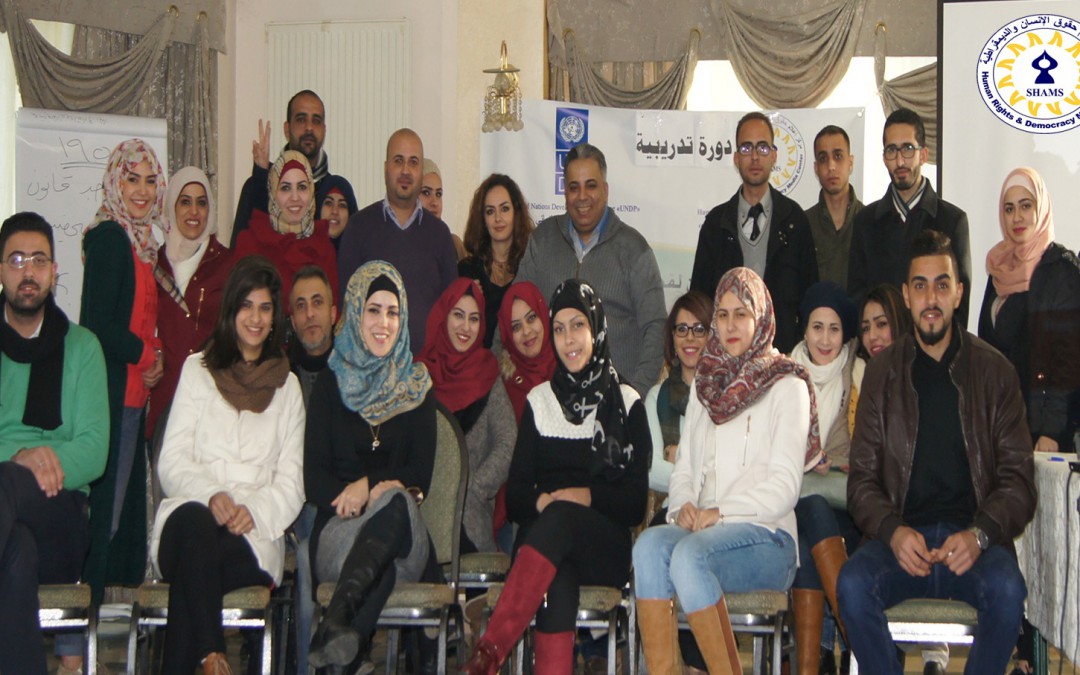
Ramallah: Human Rights and Democracy Media Center “SHAMS” conducted a training course for group of Palestinian journalists in the mass media and websites in the West Bank in Ramallah for the duration of 3 days. Training course addressed the concept of hearing & accountability sessions and mechanisms of arranging it and techniques to be taken into consideration when arranging the session.
The course included theoretical and practical sides, groups, case studies, and simulation. Dr. Omar Rahhal from “SHAMS” center inaugurated the training, welcomed the attendees, and mentioned that it aims to build the capacities of employees in local radio stations and channels.
In regard to include concepts and tools of social accountability, and capacity to arrange hearing session either live or through open meetings and reports, programs and investigative inquiries.
Also, so as to enable them to select cases, topics, prepare requirements, enhance skills of arrangement as well as mechanisms for the follow up of the findings. He added that media representative and journalists should assume an effective role in the public affair.
Participation of journalisms in the arrangement of hearing & accountability sessions is significant, in light of the absence of Palestinian Legislative Council (PLC) and it is considered as a form of public oversight and a social responsibility which is premised on media.
The training course was conducted in collaboration with United Nations Development Program “UNDP.” The trainer: Dr. Isam Abdeen Dr. Abdeen is the instructor of Democracy & Human Rights program At Birzeit University, and head of local and regional advocacy at Alhaq Organization.
He explained that advocacy seeks to gain support and mobilization for political, social, or economic issues, or towards a case of a social category for the purpose of making change in the reality, issues, and problems of this category. In such context, terms of defending, supporting and mobilization are used to indicate the concept of advocacy.
Defending may be used to represent intended action towards changing policies, positions, or programs related to any type of institutions. Moreover, defending expresses the attention of the community for a central issue and calling decision-makers for finding solutions.
It is worth noting that advocacy won’t succeed unless efforts are cooperated among individuals and organizations to make the foreseen change. Dr. Abdeen said that defending and advocacy aims to mobilizing support and organizing lobbying & advocacy campaigns, and calling for participation in making decisions that influence lives of citizens. Furthermore, Dr. Abdeen put emphasis on a numerous topics pertaining to hearing & accountability sessions, to be possible implemented by journalists. Such as the High Media Council, the General Budget of the Palestinian Authority (PA) , health, agriculture and media.
He emphasized in the training that journalists have the right to keep the confidential information even before the Public Prosecution, and that the only case in which information can be reveled is before the court.
Hearing & accountability sessions require an organized work team with particular objectives that will finally develop a report on the objectives, and it should avoid unplanned procedure, and it is necessary to select correct topic and times.
He confirmed that there should be a general plan when arranging an accountability session, and correct diagnosis for the problem besides selecting topics which affect community.
The trainer: Fadel Suleiman The trainer Fadel Suleiman addressed the concepts of integrity, transparency, and accountability in relation to hearing & accountability sessions, the public and private sectors and civil society organizations. He clarified that it is necessary to explain the terms of objectivity, integrity, and transparency accurately so as to eliminate corruption and to arrange the required sessions.
Moreover he tackled phases and procedures for arranging hearing & accountability sessions. Committee Rapporteur is responsible for selecting the topics to be raised when conducting of the session due to importance and priority.
Sometimes, topics are selected upon a written request submitted by a member or more in the committee, and then it is reviewed in the agenda of the committee to be approved by agreement or voting among members.
When having several significant topics, the committee Rapporteur develops a list with a preliminary proposal according to priority, and then it is discussed between members so as to approve and select prior topics for hearing session.
The list of priorities is approved based on professional standards and terms in the committee’s decision, while the topic of the session should be pertaining to the public affair and revealing a flaw in the performance of the general directorate to be handled by setting new public policy or modifying current status.
Also, the topic should represent a debatable theme in mass media and the public affair. Trainer Nahed Abu Te’ima The trainer Nahed Abu Te’ima participated in the third and last day of the training, and she started with presenting a video clip for an accountability session at the United Nations.
She called the attention to the importance for arrangement of Hearing & accountability sessions since it reduces injustice for victims. She clarified that both the victim and person who is held accountable by the government should exist in the session, and there should be adequate information as well as fair trial in order to achieve the goal of the session.
Additional, she mentioned that it is important for journalists to convert the hearing session into press material, and she called participants to raise deep questions within Hearing & accountability sessions.
Also she divided participants into two groups, the first one works to develop honor code for journalists that should be adhered to within sessions. The second group works to set unified terms for wiring and what should be written particularly following the end of the sessions.