
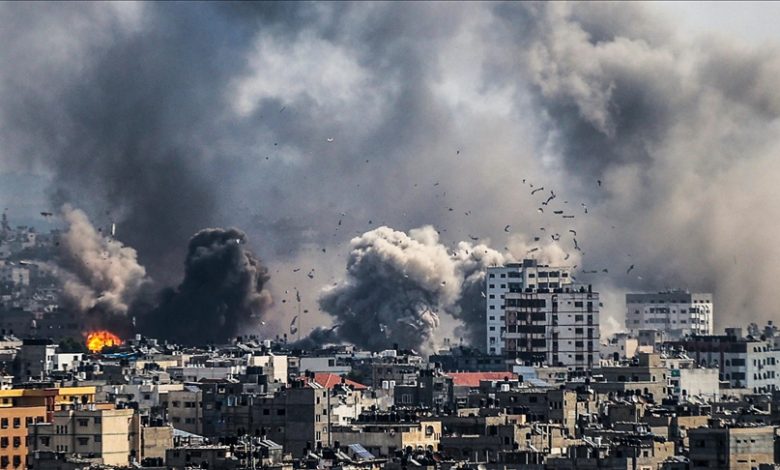
Human Rights and Democracy Media Center- SHAMS, warns of the devastating impacts of the Israeli aggression on the Gaza Strip, particularly on the environment. The Center stated that the use of internationally prohibited bombs, rockets, and weapons has led to the destruction of life’s essentials and the deliberate destruction of the natural environment, paving the way for future environmental disasters. This destruction has also extended to civilian infrastructure, including residential buildings, hospitals, schools, sewage networks, and desalination plants. Additionally, the aftermath of the weapons, especially white phosphorus bombs, thermal missiles, and seismic rockets used in the aggression, has caused extensive damage. The Israeli occupying forces employed various types of internationally banned weapons and ammunition, including cluster bombs, intensively. Numerous international reports confirm that the total amount of explosive bombs dropped on the Gaza Strip, exceeds the amount dropped on Germany during World War II, underscoring the immense scale of destruction suffered by the Gaza Strip in a short period.
Shams Center emphasizes that the consequences resulting from the destruction of civilian and economic facilities, as well as the remnants of ammunition and weapons, have profound impacts on the environment and its components in the Gaza Strip. These impacts interact with essential environmental elements, especially soil, water, and air, potentially rendering the Gaza Strip uninhabitable in the future due to the existing pollution resulting from war. Pollution manifests from various sources, most notably the waste of bombs, weapons, and ammunition used, which cause radiation and directly contribute to environmental pollution. Additionally, the rubble of destroyed buildings, the decomposition of thousands of bodies under the debris, and the remains not extracted by civil defense teams all contribute to environmental and societal health disasters. The cessation of municipal services, activities of popular committees, and the relevant health departments in waste collection have led to the rotting of waste, resulting in immediate and future health and environmental disasters. The ongoing aggression has also caused catastrophic environmental effects due to the destruction of sewage networks, leading to the leakage of sewage into groundwater wells in Gaza. All groundwater wells have become contaminated, posing an imminent and distant health and environmental catastrophe. Groundwater in the Gaza Strip serves as the primary source of drinking water for citizens, and its contamination leads to various diseases, epidemics, and negative effects on the entire ecosystem. This is particularly critical in the context of the destruction of hospitals, and primary healthcare centers, and the collapse of the healthcare system in the Gaza Strip
Shams Center emphasizes that the environmental impacts of the ongoing Israeli aggression on the Gaza Strip will have long-term future effects. The effects of these materials require many years to eliminate, especially in the soil, leading to the spread of infectious diseases and contamination of groundwater and seawater. The real and catastrophic effects resulting from the Israeli aggression on the environment and its elements will be revealed in the future after the stopping of military operations, the end of aggression, and the return of civilian life to the Gaza Strip. It is then that the negative environmental impacts and their effects on the residents will begin to emerge to the surface. This is because the current focus is primarily on the enormity of the tragedy, with extensive killing, destruction, and aggression, and less attention is given to the environmental issue and their impact of environmental destruction, on the citizens.
SHAMS Center notes that the environmental pollution resulting from the ongoing Israeli aggression on the Gaza Strip constitutes a grave violation of international human rights law regarding the right to live in a healthy and clean environment. This is especially pertinent to the International Covenant on Economic, Social, and Cultural Rights, as Article 12 of the Covenant states that parties to the Covenant shall take necessary measures to secure the full realization of this right. These measures include improving all aspects of environmental and industrial health, preventing and controlling epidemic, endemic, occupational, and other diseases, and providing medical services and healthcare to everyone in times of illness. The environmental pollution also amounts to a violation of international humanitarian law, as environmental pollution is one form of collective punishment. This is evident in the First Additional Protocol to the Geneva Conventions, Article 54, concerning the protection of objects indispensable to the survival of the civilian population. It explicitly prohibits the attack, destruction, transportation, or impairment of objects and materials indispensable to the survival of civilians, including foodstuffs, agricultural areas producing food, crops, livestock, drinking water facilities, their networks, and irrigation works if the intent is to deprive civilians of these or to undermine their vital importance, regardless of the motive, whether to starve civilians, force them to evacuate, or for any other purpose. Furthermore, it is a violation of what is stipulated in the Second Additional Protocol to the Geneva Conventions concerning the protection of victims of non-international armed conflicts, especially in Article 14, which prohibits the starvation of civilians as a method of warfare. Thus, it also prohibits the attack, destruction, transportation, or impairment of objects and materials indispensable to the survival of the civilian population, such as foodstuffs, agricultural areas producing food, crops, livestock, drinking water facilities, their networks, and irrigation works.
Shams Center calls on the United Nations Environment Programme, the World Health Organization, the World Meteorological Organization, various UN-affiliated institutions, governmental and non-governmental organizations working in the fields of climate and the environment, as well as international human rights organizations, to fulfill their duties and exert pressure on the Israeli occupation government to cease direct targeting and systematic destruction of the environment in the Gaza Strip