
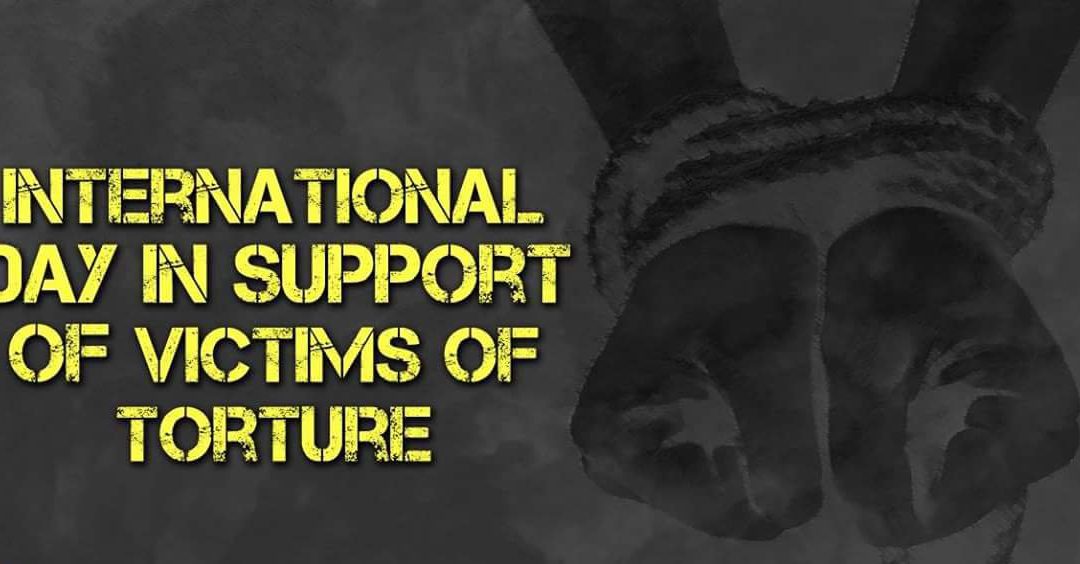
“SHAMS” Center condemns with the strongest and harshest terms the systematic torture practices, the violent as well as inhumane approaches, and the various human rights violations perpetuated by “Israel,” the settler-colonial occupying power through the various components of its system including soldiers, the police, investigators, settler’s terrorism, and a complicit judicial system against Palestinian citizens and particularly prisoners whose population, according to the most recent figures, has reached 5300 including 250 children, 40 women, 250 prisoners in administrative arrest, hundreds of patients, and a number of journalists.
“SHAMS” Center reminds that “Israel,” the occupying power, is the only country in the world that dared to publicly legitimize torture and sponsor it through the law. On the 8th of November 1987, the Israeli Knesset approved the recommendations presented by the Landau Commission, which had been formed earlier by the Israeli government in order to find a legal escape in light of the increasing criticism directed at the interrogation methods applied by the Israel Security Agency “Shin Bet” against Palestinian prisoners. The committee introduced a “legal” cover for the problem faced by the Shin Bet by allowing it to exert “physical and psychological pressure” onto prisoners accused of committing “an act of …terror.” Under this pretext, the committee allowed Israeli officers and interrogators to use and legitimize torture, which goes to show with clarity the occupation’s integrated colonial establishment.
The occupation state has persisted through a long string of procedures, practices, and legislations in applying various forms of torture and mistreatment on the basis of a racist and discriminatory ideology rooted in the supremacy of Jewish Israelis over Palestinians living in the area extending from the Jordan River to the Mediterranean. It has also ensured that criminals who committed crimes in this regard are exempt from punishment and accountability, which it accomplished by repeatedly barring international investigation committees from accessing the Occupied Palestinian Territory, impeding the efforts of international courts including the International Criminal Court (ICC), exerting pressure against the judges of these courts, and prosecuting and intimidating human rights defenders.
“SHAMS” Center emphasizes that, despite Palestine’s accession to a number of international agreements and conventions including the Convention against Torture and Other Cruel, Inhuman or Degrading Treatment or Punishment in 2014 and the Optional Protocol attached to it in late 2017, it nonetheless has not yet undertaken any serious procedures at the levels of legislations and practices that reflect a serious intent to commit or implement the Convention. The Convention is yet to be published in the official Gazette. Additionally, the announcement of a national preventive mechanism against torture or a strategy to oppose the practice, provide justice to victims, and hold perpetrators accountable, a formal announcement of the State of Palestine’s willingness to open its detention centers up for supervision, and a formal rejection of torture as a practice by all of the State’s forces are still far-fetched measures that require much effort to happen.
“SHAMS” Center views with alarming concern the increasing complaints and testimonies delivered by citizens about being subjected to torture and mistreatment by the security forces, and particularly complaints presented against the Joint Security Committee. According to testimonies delivered under the oath by detainees, various forms of torture are adopted by the security forces, including beatings with a stick on various parts of the body, beatings with a hose, slapping, violent strikes to the face, suffocation, banging the head against a wall, feet strikes to the abdomen, being forced to stand barefoot in cold water, being aerially suspended from the arms and feet for long periods of time, sleep deprivation, being barred from taking showers, being cursed at with offensive terms, being cursed at with terms that violate one’s religious beliefs, being blindfolded, being spat at, detention in extremely narrow and unclean cells, interrogation for days at a time, deprivation of family visits, threats of beatings, murder threats, and other forms of cruel and inhumane forms of torture that led victims in numerous cases to lose consciousness and have their health deteriorate. These torture and mistreatment practices have increased in number coincidentally with the recent increase in summons and political arrests of citizens due to their practice of their right to express their opinions, their political affiliation, and their right to free assembly.
“SHAMS” Center emphasizes that this suppressive policy has recently claimed the life of the political activist, human rights defender, and former candidate to parliamentary elections Nizar Banat, who died two hours after he was arrested by a large group of the Palestinian Preventive Security and General Intelligence forces. The circumstances of Banat’s death have ignited a widespread wave of anger after members of his family testified that he was severely beaten with wooden and metal batons. This incident calls for a serious and decisive investigation the findings of which ought to be made accessible to the public in complete objectivity, accuracy, and a desire to hold perpetrators accountable and provide justice to the victim’s family. Other death cases have taken place at detention centers, but neither the circumstances surrounding those deaths nor the procedures undertaken to investigate them have been made accessible to the public.
In light of these developments, “SHAMS” Center emphasizes the importance of the following:
- The exertion of the utmost pressure against the occupation state to criminalize torture measures it undertakes against Palestinian prisoners, commit to international law and the human right system, prosecute those who committed acts of torture and then broaden the scope of accountability to include anyone who participates in any form in the perpetuation of torture.
- Following-up on the conditions and circumstances of still-imprisoned and freed Palestinian prisoners from Israeli prisons in all aspects. Additionally, due to being victims of torture, care and support in the spheres of physical and mental health must be provided to them by civil and governmental institutions to help them resume their lives ordinarily and healthily.
- Urging the International Committee of the Red Cross to uphold its legal and humanitarian responsibilities, maintain effective contact with Palestinian prisoners, monitor their circumstances in Israeli prisons, and notify their families of their conditions.
- Calling on local and international civil society institutions to monitor, document, launch lobbying and advocacy campaigns, and capitalize on membership in various alliances with regards to the crimes of torture and mistreatment suffered by Palestinian prisoners from various authorities.
- Immediate implementation of the international agreements, conventions, and documents to which the State of Palestine has acceded including the Convention against Torture and Other Cruel, Inhuman or Degrading Treatment or Punishment. These agreements and conventions ought to be published in the official Gazette, a national mechanism must be formulated, and all legislations and practices that pose a contradiction to democracy and human rights must be suspended.
- The integrous, objective, and transparent formulation of an independent investigation committee in the murder of the citizen Nizar Bant. The committee must include a medical examiner that represents Banat’s family. The investigation must be responsive, effective, and thorough. The investigation’s conclusions and recommendations must be published and the public must be granted access to them in accordance with its right to access information. In addition, the committee’s conclusions and recommendations must be fully implemented, perpetrators must be held accountable in a manner that achieves private and public deterrence, and procedures must be undertaken to ensure that similar incidents never occur again in the future.
- The re-consideration of the security establishment’s policy of systemic targeting of political and human rights activists through the re-construction of the establishment’s ideology on a new basis rooted in respect for human rights and public as well as private freedoms, the protection of citizens from any external aggression, preservation of democratic practices, bypassing political polarization, enforcement of the law in accordance with international agreements and best standards, the protection of the Basic Law (interim constitution) and constitutional institutions, maintenance of civil peace, commitment to transparency and integrity, and maintenance of monitoring practices in the work of the security forces.
- The resumption of the electoral process and organization of public, inclusive and simultaneous elections through an agreed-upon elections law and a transparent elections court. Such steps must be undertaken to respect the principle of peaceful transition of authority and the people’s right to grant legitimacy to the governing authorities. They would also require the establishment of a transparent and free electoral environment where the democratic process is enhanced.