
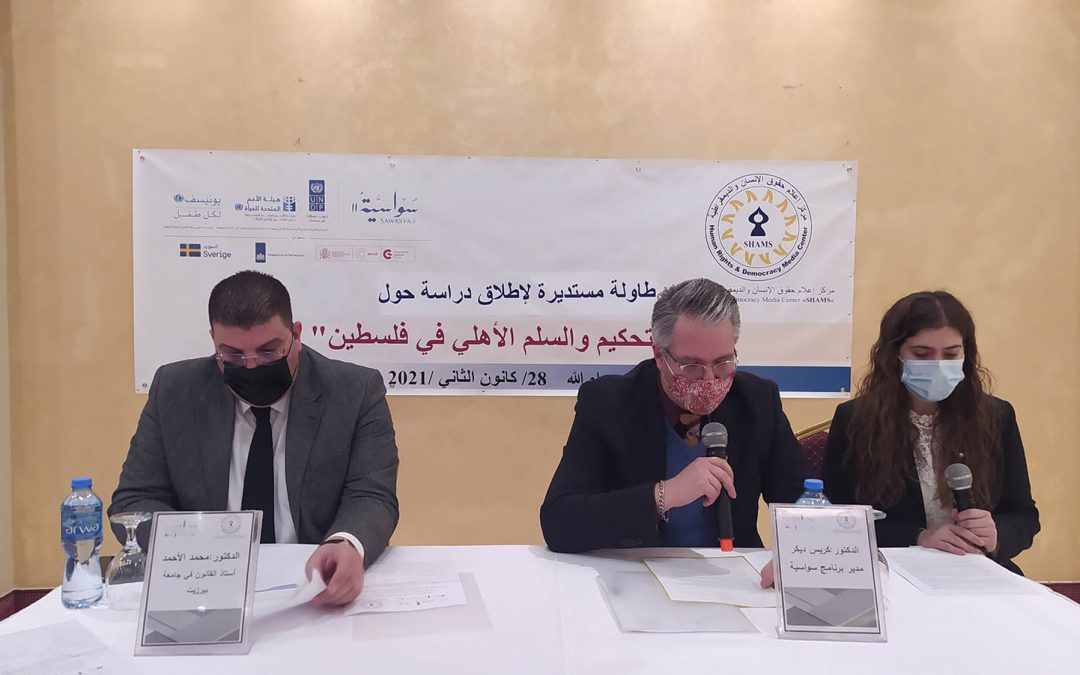
Ramallah: the Human Rights & Democracy Media Center “SHAMS” organized a meeting to launch a study on “arbitration and civil peace in Palestine.” The meeting was attended by representatives of official institutions, civil society institutions, chambers of commerce, unions, arbitrators, researchers, academics, and social activists. This meeting was organized within the project “enhancing citizens’ accessibility to formal alternative dispute resolution methods” and supported by the joint Sawasya program.
The director of Sawasya program in Palestine Dr. Chris Decker spoke about Sawasya being a joint program of the United Nations Developmental Program and its role in the promotion of the rule of law in Palestine, the support to partners in their development of effective legal programs, and the promotion of alternative dispute resolution methods, hence improving the services of the Palestinian justice system.
Dr. Muhammad Al-Ahmad, an accredited arbitrator and a professor of civil law at Birzeit University, spoke about the concept of online arbitration in the Egyptian, Jordanian and Canadian arbitration laws and as well as other international laws and agreements. He also discussed the formulation of the arbitration clause and the adaptability of the rules governing traditional arbitration to the online form. In addition, Dr. Al-Ahmad talked about the attributes of the online arbitration agreement, its merits, the obstacles facing online arbitration, and online arbitration’s ruling.
Afterwards, the researcher Dr. Talal Abu Rukba presented his study, which addressed the efficiency of arbitration as a formal justice tool in the protection of civil peace in the Palestinian society, and its ability to confront crises and disputes within it. The study aimed to investigate if arbitration is indeed effective as a civil peace tool and in its quest to protect society in light of all the crisis-induced changes imposed on the Palestinian community. The changes are attributed to Israeli policies whose goal is the limitation of Palestinian rule of law in all of the Palestinian Territories and particularly in Areas (C) of the West Bank, including East Jerusalem. Other factors that the study took into consideration included the challenges presented by the Covid-19 (Corona) pandemic, its implications on the economic state, the extent to which official institutions are committed to activate arbitration as a formal dispute resolution tool, the importance of promoting it as a mechanism that enhances the rule of law concept by connecting it to legal and rightful concepts, employing it effectively in the defense of marginalized groups in society, and benefitting from Arab experiences.
The attendees then discussed a number of issues like the absence of arbitration culture from the Palestinian society, the lack of interest in the promotion of arbitration exhibited by the formal Palestinian institutions, and raising citizens’ awareness regarding it. The discussion then moved to the obstacles that impede the work of arbitration as a phenomenon. Such obstacles included judge replacement in courts, which prompts each judge to review the cases from scratch even though his/her job is only to complete them, a process that lengthens arbitration cases. Other obstacles that were discussed were arbitrators’ high fees, and the incomprehensiveness of arbitration in all sectors.