
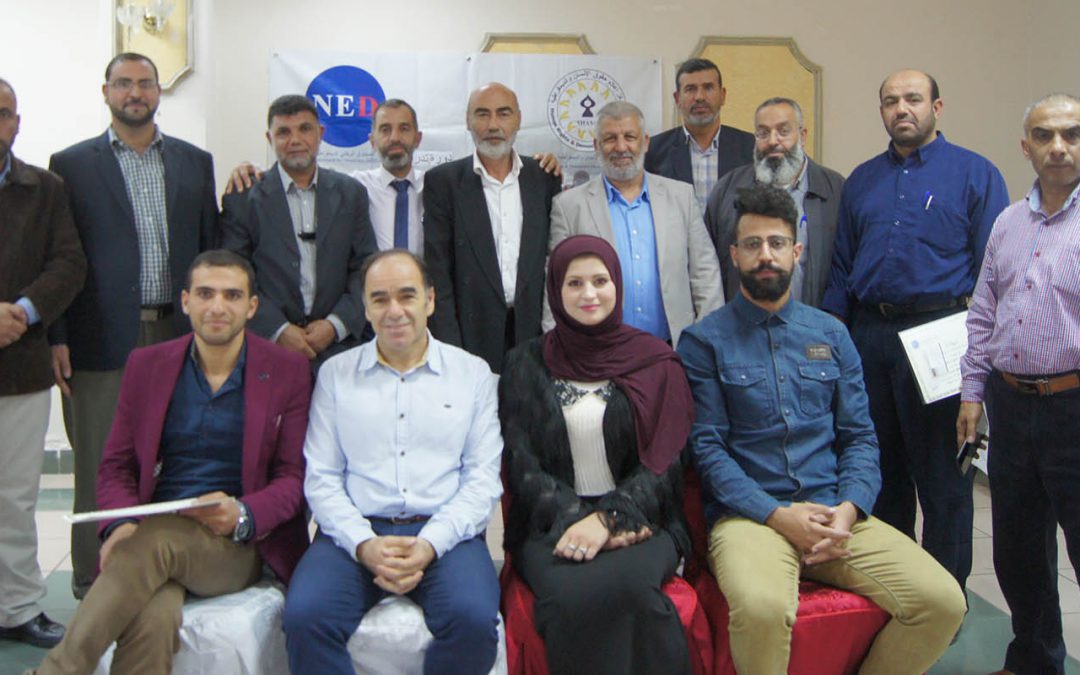
Ramallah: Human Rights and Democracy Media Center “SHAMS” concluded a training course on human rights and democracy, in collaboration with Ministry of Higher Education. The course was attended by a group of Islamic Education teachers, participating from the governorates of Hebron, Jenin, Ramallah & Albireh, Nablus, Bethlehem, Tubas and Tulkarm, under the support of the National Endowment for Democracy (NED).
The training course aimed at building the capacities of Islamic Education teachers regarding the concepts of democracy & human rights, citizenship and basic freedoms, contained in international conventions on human rights as well as the Palestinian legislation. Besides, strengthen their capacities in critical and creative thinking.
For his part the trainer Huthaifa Saeed addressed the concept of citizenship and its definition. Also he discussed the very root of citizenship based on participation and equality, by adopting practical exercises and dividing participants into participatory working groups to share ideas & viewpoints and create a kind of constructive debate.
On his part, the trainer Nasser Matar talked about the concept of tolerance; he defined it as a certain type of relations between individuals and groups based on the basis of accepting others, a right that shall not be waived. Indicating the importance of tolerance and its necessity in society, and he explained it to the participants through various exercises.
Whereas the trainer Fadel Suleiman tackled the freedom of opinion and expression, defining the freedom of expression as the ability to express the viewpoints of each individual using one of the means available for that, whether by writing, speaking or other method without the prohibition of any one or any other mechanisms. Also, he talked about the concept of incitement, indicating the difference between it and freedom of opinion. He addressed media as a fourth estate, as well as obstacles that prevent the Palestinian media outlets from assuming its role, following the method of discussion through sharing some examples and raising several issues.
While Dr. Moris Baqleh addressed critical thinking in terms of definition, characteristics, skills and importance. Besides, he tackled the relationship between critical thinking and problem solving, the key obstacles facing this type of thinking, and creative thinking, the required mechanism to promote, discover and leverage it through building and accumulation, and the importance of this type of thinking at the personal and public levels.
At the end of the training course, participants recommended the need to establish the freedom of opinion for both the teachers & students under certain restrictions, and to conduct additional training course which target the teachers of Islamic education as a group rarely targeted, and hold more courses on public freedoms and creative & critical thinking. In addition, the need to build bridges of confidence between students and teachers, whereas the teacher shall work hard to represent a role model for students to create an active students capable of expressing themselves. And to change the stereotypical images about the strictness of Islamic education teachers because they are most effective at schools, and involve them in training courses, and apply the content & lessons learnt in training courses at schools and in public.