
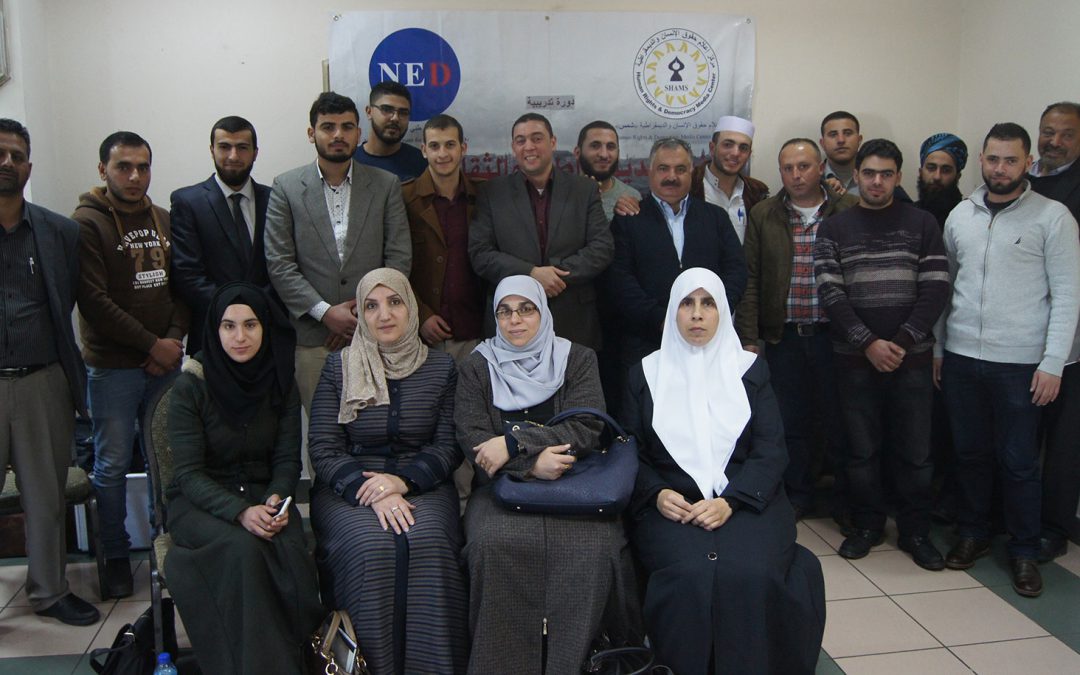
Ramallah: human Rights and Democracy Media Center “SHAMS” completed a training course for Sharia students on critical thinking and freedom of opinion & expression. Attended by a number of students who study sharia in different colleges and universities in the West Bank. This course is a part of the project enhancing civil culture among Sharia students, which is implemented by the center in collaboration with National Endowment for Democracy (NED).
Hanan Mousa, the project coordinator initiated the training course. She welcomed the attendees and put emphasis that training sharia students on critical thinking and freedom of opinion & expression is of high importance.
Dr. Ahmad Abu Dayya, the trainer addressed the freedom of opinion & expression and explained that there has been a conflict in the history about humans and possibility to express their opinion as they prefer, or restrict the freedom of opinion, also he defined the freedom of opinion & expression as the right to express one’s viewpoint by speech, writing, arts, publishing or whatever possible without prevention or restriction. He mentioned that this freedom includes extensive terms and there is no limited precise definition for it.
Moreover, Huthaifa Said the trainer tackled the topic of critical and creative thinking.
Critique is checking the thing to know both the positive and negative points. While Critical thinking rationale aims to look in the issues for new ideas. The trainer explained that critical thinking is an important process for everyone to deal with all the fields of life and prevent problems due to dissimilarity in opinions. Accepting others and openness towards different viewpoints should be enhanced, away from extremism or personal attitudes. It is important to encourage such kind of thinking to eliminate forms of negative thought and intellectual fanaticism.
At the end of the training course, participants recommended not restricting the freedom of opinion & expression. Besides, they recommended raising children to adopt critical and creative thinking, applying it at schools and other education institutes, accepting other opinions, and preventing bias to personal viewpoint.