
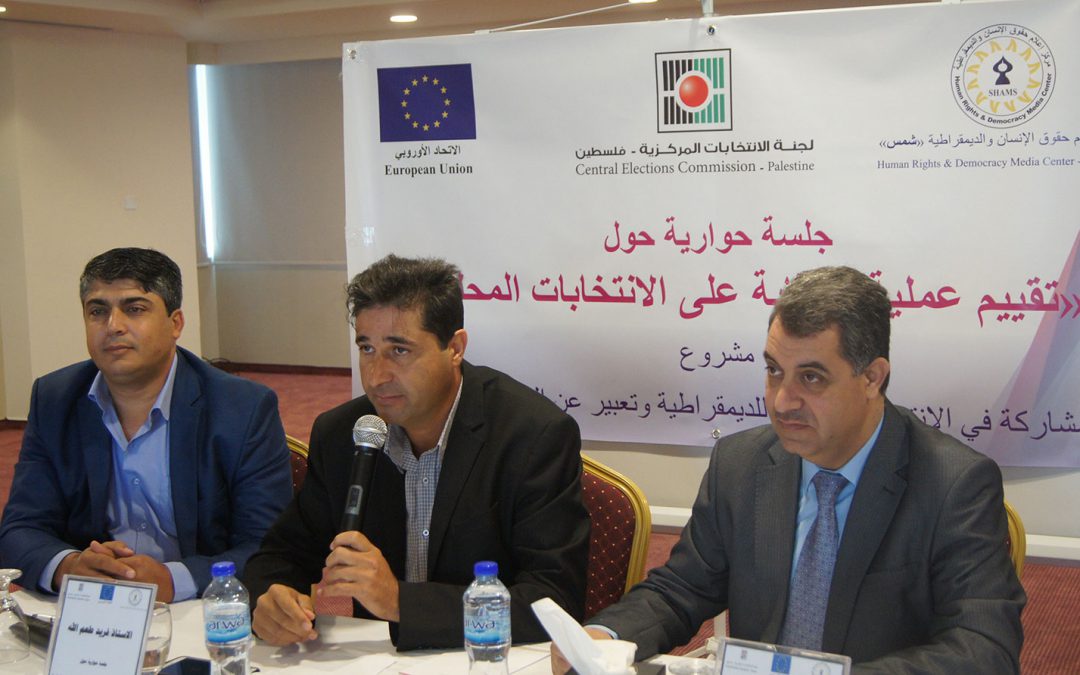
Ramallah: Human Rights and Democracy Media Center “SHAMS” in collaboration with Central Elections Commission CEC under the support of the European Union organized a dialogue sitting to evaluate the process of observing elections of local authorities. Attended by the representatives of civil society organizations CSOs who participated as observing bodies to present the experience of their organizations in observing electoral process.
Jihad Harb, the researcher in government issues explained that independent and biased civilian oversight on elections and its phases is an important contribution to the field follow up for the progress of the electoral process, to assess and to identify abidance to legislations, by-laws and instructions. Starting from registration, publicity, objection, candidacy, voting, winning, announcing preliminary results, appeal, courts’ decisions and the official and accredited announcement of results. In order to guarantee the security of the electoral process by achieving comprehensive and detailed reports on the progress of elections to be employed when conducting an objective and accurate evaluation. Through which a set of findings and recommendations should be taken into consideration for upgrading and enhancing phases of electoral process in line with international criteria of human rights.
In this regard, it is worth noting that CSOs assume a significant role of dynamic contribution by following, monitoring and evaluating electoral process in light of independent biased observing within requirements of the laws of Palestinian elections: local authorities, presidential and legislative. In addition to the efforts paid by the Independent Commission for Human Rights ICHR as a constitutional body in this regard which add a professional element to strengthen values of citizenship, and encourage political participation for citizens. By reinforcing civil and political rights as well as respecting transparency and integrity of elections’ results.
Farid Tu’mallah, media coordinator at the CEC mentioned some negative points in observing the electoral process. In terms of being a periodic process sine observing is focused on voting day, lack of experience among some of the local observers who are not fully aware of their role in observing and the Law of Elections. Additionally, some civil society organizations which participated as observing bodies on the elections didn’t submit the required reports. Also, he explained that the sitting aims to upgrade and improve the performance.
Moreover, the representatives of CSOs who joined the meeting and presented some of their experiences participated as observing bodies have agreed that observing was focused on voting day and there is a problem in observing procedures following the elections since it should be comprehensive for the phases of electoral process. Participants recommended the need to rehabilitate voting centers, having regular follow up by the CEC for elections’ observing institutions, and calling organizations working in this field and civil society organizations to upgrade the work in regard to observing. Besides, changing the system of elections, working hard to keep the CEC an independent body and assuring that observing should be a comprehensive electoral process earlier and subsequent and during all phases of elections. Additionally, they recommended the necessity to have coordination and fair distribution of missions in all areas and increasing the powers of the CEC in stopping violations occur during, before or after the electoral process. Furthermore, enhancing genuine representation for women and youth in the elections, extending collaboration with political parties and amending the applied laws for making change on the ground and adding materials to universities to encourage youth participation in the electoral process.