
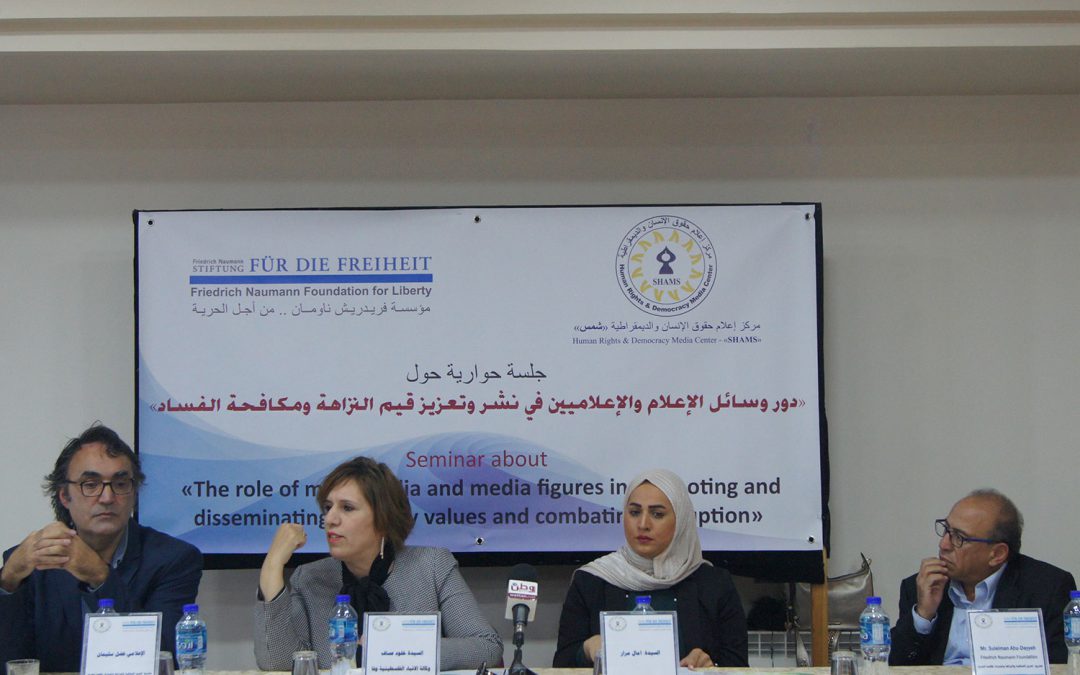
Ramallah: media figures recommended the importance to strengthen the connection between journalists and civil society organizations in order to enhance values of integrity, transparency and combat corruption. Also, the importance of empower independent media, and to request conducting a roundtable combining chief editors in different media institutions to assess the progress of Palestinian media. In addition to activate an extended civil coalition for endorsing the law of access to information, to encourage media institutions towards refreshing and developing investigative journalism by providing necessary potentials and to amend Cybercrimes Law. Moreover, to develop and implement specialized training courses for journalists to raise their awareness on corruption issues, to establish a network of journalists, media figures and legalists against corruption and to strengthen and activate the Syndicate of Journalists. The previously mentioned were addressed during a seminar held by “SHAMS” Center funded and collaborated with Friedrich Naumann Foundation FNF combining workers at local and Arabic media institutions. Which is entitled (The role of mass media and media figures in promoting integrity and transparency values and combating corruption”. Besides, the challenges facing workers at media outlets so as not to address corruption cases and access to accurate information based on actual documents and facts.
Amal Murrar, the journalist who facilitated the seminar put emphasis that meetings and workshops are conducted as a continuation for previous meetings held by the center. She pointed to the significance of media role in putting the spotlight on corruption cases in collaboration with decision-makers. Also, she addressed Palestine’s signature and ratification on international conventions against corruption.
Fadel Suleiman, the media figure presented a working paper on the role of media in promoting integrity and combating corruption. In which he indicated that corruption exists even in states of democratic regimes, while undemocratic regimes represent a supporting atmosphere for corruption. Democratic regimes combines balanced independent powers, provides free and fair elections as well as peaceful deliberation of authority where freedom of expression, free press and independent fair jurisdictions are protected. So, practicing corruption in democratic regimes is hard and hazardous process carrying unguaranteed results on the corrupted. Suleiman emphasized the importance to enact a legislation to regulate asking for the information by the researcher journalist, cases of approval or refusal of the acclimation and controls information allowed to be disseminated. In his paper, he also addressed forms of awareness, mobilizing the public opinion, corrupted media, code of conducts, ethics and laws and recently the Law of Cybercrimes and he called for amendment on this law.
Khuloud Assaf, chief editor at Palestinian Info & News Agency (WAFA) indicated that corruption occurs but not to a large extend, and she said that we as Palestinian people living under the Israeli occupation shouldn’t punish ourselves. Additionally, she pointed to investigations issued on corruption but it is considered few if compared to the number of media figures and journalists working at media outlets. She added that fresh graduates of media lacks the experiences and needs rehabilitation courses before joining press work.
Besides, Suleiman Abu Dayya the representative of FNF pointed to the importance of media in revealing corruption and addressing corruption topics but objectively without insults to individuals. And he requested to communicate with chief editors in newspapers and media outlets to collaborate on developing press reports on corruption.