
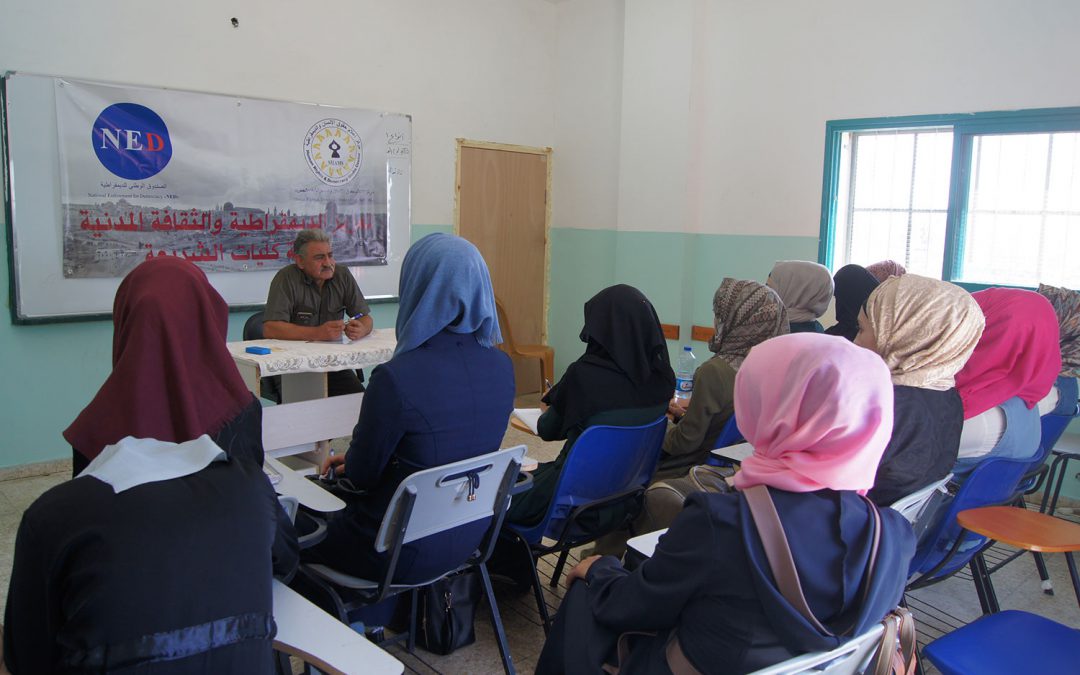
Ramallah: Human Rights and Democracy Media Center “SHAMS” conducts a workshop on religious liberties, in Islamic Da’wa College at Aldahriya attended by a group of Sharia students. This workshop is a part of the activities of “Disseminating democracy and national culture” project which is funded by National Endowment for Democracy (NED). With this project, the center aspires to enhance concepts of democracy and civil culture within its hard work with community sectors.
Dr. Nidal Abu Ayyash spoke about religious liberties, and assured that religious liberty should be accessible and guaranteed as a human right enjoyed by humans, which is guaranteed by international conventions. The right to religious liberty or belief within human rights indicates individual freedom to choose a religion or no religious. Article (18) of International Covenant on Civil and Political Rights mandates freedom of religion or belief, and assures that each person has the right to choose freedom of belief or religion. In terms of choosing what to believe, freedom of belief or religion, freedom to reveal the belief or religion and practicing rituals and education both individually or collectively.
Significance of religious freedoms is represented in considering democracy as a social system and that extent of democracy within a certain community is measured by the sense of equality, freedom, brotherhood as well as freedom of faith-based institutions, freedom of religious expression like other civil freedoms. Moreover, freedom of belief isn’t represented only in securing freedom of religion or individual belief, but also the unassigned individual legal element. Religious freedom signifies peoples’ liberty to choose the religion, no religion or the type of life they want to adopt hence, no one is allowed to force other to believe or leave a certain religious group.
What is required in this regard is to activate intellectual and logical dialogue, to address central topics away from sectarianism and to formulate a national observatory for religious speeches to monitor texts and legislations, and what is tackled by Imams on platforms. In addition to analyze the contents of speeches, to identify related attitudes and to submit recommendations to faith-based stakeholders. It is important to reject hatred and fanaticism, to strengthen speeches of tolerance and accepting others and to enhance the respect for religious freedoms as a guaranteed human right and to conduct similar activities.